TCAVA Explained: Pros, Cons, Section 108, and What the Take Care of America’s Veterans Act Means for Veterans
Understanding the Take Care of America’s Veterans Act (TCAVA): A Balanced Look at the Benefits, Concerns, and Ongoing Debate
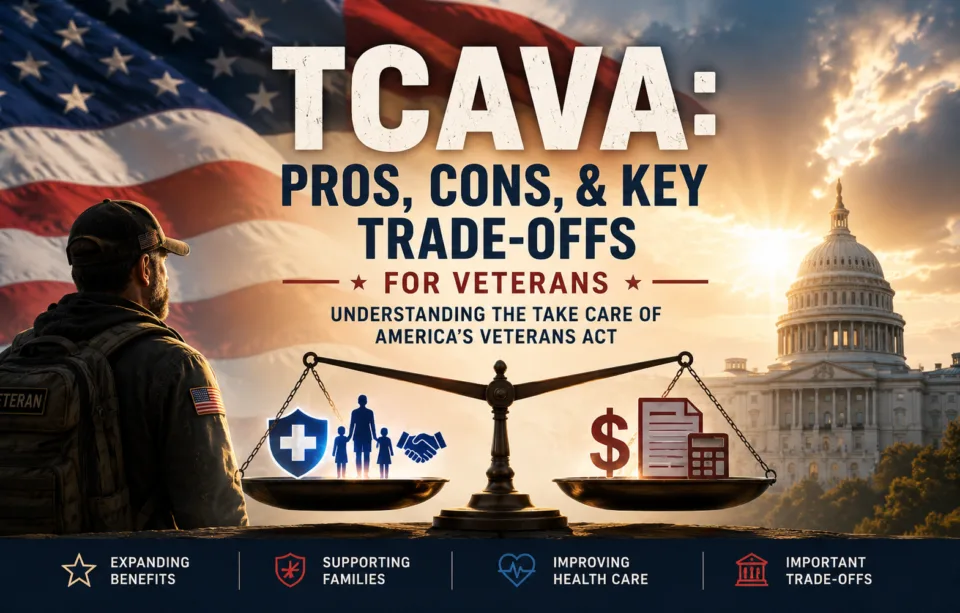
The Take Care of America’s Veterans Act (TCAVA), introduced in June 2026 as H.R. 9237 in the House and S. 4744 in the Senate, is one of the most comprehensive veterans’ legislative packages considered by Congress in recent years. Introduced by House Veterans’ Affairs Committee Chairman Rep. Mike Bost (R-IL) and Senate Veterans’ Affairs Committee Chairman Sen. Jerry Moran (R-KS), the legislation combines more than 60 previously introduced bipartisan veterans’ bills into a single omnibus package.
The legislation seeks to modernize the Department of Veterans Affairs (VA), expand benefits for many veterans and their families, improve survivor benefits, strengthen caregiver support, enhance education programs, and address long-standing priorities such as the Major Richard Star Act.
Despite broad bipartisan support for many individual provisions, TCAVA has become one of the most debated veterans’ bills in recent years because of how portions of the package are funded. While some veterans’ organizations strongly support advancing the legislation, others oppose it in its current form, arguing that certain cost-saving provisions could reduce disability compensation for future veterans.
This article presents both perspectives so readers can better understand the legislation and form their own conclusions.
What TCAVA Would Do
Supporters describe TCAVA as a rare opportunity to move dozens of long-supported veterans’ priorities through Congress in one legislative package rather than waiting years for each bill to advance individually.
Among its major provisions are:
Major Richard Star Act (Concurrent Receipt)
One of the bill’s highest-profile provisions would allow many combat-injured military retirees to receive both their full military retired pay and full VA disability compensation.
Current law requires many medically retired combat veterans to forfeit a portion of their retirement pay because of the longstanding VA disability offset. Veterans’ organizations across the political spectrum have advocated for eliminating this offset for years, making the Major Richard Star Act one of the most significant components of TCAVA.
Expanded Survivor Benefits
TCAVA incorporates provisions from legislation such as the Love Lives On Act, expanding eligibility for certain surviving spouses and making additional improvements to Dependency and Indemnity Compensation (DIC) and other survivor programs.
These changes are intended to improve financial security for surviving military families and eliminate several long-criticized restrictions affecting remarried spouses.
Caregiver and Family Support
The legislation expands assistance for family caregivers of severely disabled veterans while making improvements to several caregiver-related VA programs.
Supporters argue these changes better recognize the role family members play in caring for veterans with catastrophic injuries and chronic illnesses.
VA Modernization and Healthcare Improvements
The bill also includes numerous provisions designed to modernize VA operations, including:
- Improvements to healthcare delivery
- Expanded mental health initiatives
- Suicide prevention programs
- Enhanced Transition Assistance Program (TAP) services
- Administrative modernization and technology improvements
- Various efforts intended to reduce bureaucracy and improve access to care
Many of these proposals have enjoyed bipartisan support for several years.
Education and Employment
TCAVA also contains provisions affecting education and workforce transition, including updates to certain GI Bill programs, apprenticeship housing allowances, and employment-related benefits intended to help veterans successfully transition into civilian careers.
Why Many Organizations Support TCAVA
Supporters argue that Congress rarely has the opportunity to advance such a large number of veterans’ priorities in a single legislative package.
Organizations supporting the legislation generally point to several factors:
- The bill advances dozens of bipartisan proposals that have been introduced repeatedly over multiple Congresses.
- It includes long-sought reforms such as concurrent receipt through the Major Richard Star Act.
- Many provisions have already been vetted through committee hearings and stakeholder input.
- An omnibus package may represent the most realistic path to enactment in a closely divided Congress.
For these organizations, the legislation represents meaningful progress that could benefit hundreds of thousands of veterans and surviving family members.
The Primary Controversy: Section 108
The overwhelming majority of criticism surrounding TCAVA centers on Section 108, which would change how the VA evaluates future disability claims involving tinnitus and obstructive sleep apnea.
Importantly, Section 108 generally applies prospectively. Veterans who already have established disability ratings for these conditions generally would not have those existing ratings reduced solely because of these statutory changes. Future implementation would still be subject to the bill’s final language, VA regulations, and administrative guidance.
Proposed Changes to Tinnitus Ratings
Current VA regulations generally allow veterans diagnosed with recurrent service-connected tinnitus to receive a 10% disability rating, regardless of whether one or both ears are affected.
Section 108 would significantly narrow that approach.
Under the proposal, tinnitus generally would no longer receive its own standalone compensable disability rating except in limited circumstances, such as when associated with otherwise noncompensable service-connected hearing loss.
Proposed Changes to Sleep Apnea Ratings
The legislation would also revise how the VA evaluates obstructive sleep apnea.
Under current regulations, many veterans prescribed a CPAP or similar breathing assistance device qualify for a 50% disability rating.
Section 108 would replace that framework with ratings more closely tied to the effectiveness of treatment and the severity of ongoing symptoms.
The proposed schedule would generally provide:
- 0% when the condition is asymptomatic regardless of treatment;
- 10% when treatment provides incomplete symptom relief;
- 50% when treatment is ineffective or cannot be used because of qualifying comorbidities (without end-organ damage);
- 100% when the condition results in qualifying end-organ damage.
Supporters argue these changes better align compensation with the current medical understanding of both conditions.
Critics argue the changes would substantially reduce compensation for many future veterans compared to today’s rating schedule.
Why Section 108 Is So Controversial
The controversy is less about whether the VA has previously considered updating its rating schedule and more about how these changes are being used within TCAVA.
According to estimates cited by the Department of Veterans Affairs and referenced by several veterans’ organizations, the proposed changes could produce approximately $57 billion in projected federal savings over ten years. Those projected savings help offset the cost of expanding other benefits included in the legislation, including the Major Richard Star Act.
Critics argue that this effectively asks one group of veterans—future disability claimants—to help finance expanded benefits for another group.
Concerns Raised by Opponents
A coalition of veterans’ organizations—including Common Defense, the Veterans of Foreign Wars (VFW), Disabled American Veterans (DAV), Paralyzed Veterans of America (PVA), Iraq and Afghanistan Veterans of America (IAVA), and others—has publicly opposed Section 108.
Their primary concerns include:
- Future veterans with legitimate service-connected disabilities could receive less compensation than veterans filing similar claims under current law.
- Congress would be using statutory disability-rating changes as a budgetary offset rather than allowing the VA’s scientific and medical review process to determine rating criteria independently.
- Veterans’ earned disability compensation should not be used to finance unrelated benefit expansions.
- Congress should instead identify alternative funding sources, such as other federal spending reductions or appropriations, rather than reducing projected disability compensation for future claimants.
Several lawmakers have introduced amendments seeking to remove Section 108 and replace the funding offsets with alternative budgetary mechanisms.
Additional Funding Provisions
Section 108 is not the only funding-related provision that has generated discussion.
The legislation also proposes adjustments to certain VA home loan funding fees, which some organizations argue could increase costs for some veterans and service members using the VA Home Loan Guaranty Program.
Supporters contend these adjustments are necessary to help finance the broader package while maintaining fiscal responsibility.
Why Veterans’ Organizations Disagree
One reason TCAVA has generated so much debate is that veterans’ organizations are largely united on what they want to accomplish but divided on how to accomplish it.
For example:
- The American Legion has publicly supported moving the legislation forward, emphasizing that it provides the best available opportunity to enact dozens of long-supported veterans’ priorities, including concurrent receipt.
- Other organizations—including the VFW, DAV, PVA, IAVA, and members of the Common Defense coalition—have urged Congress to remove Section 108 before final passage while continuing to support many of the bill’s other provisions.
This disagreement reflects differing views on legislative strategy rather than disagreement over the importance of improving benefits for veterans.
Current Legislative Status
As of late June 2026, TCAVA had advanced through the House Veterans’ Affairs Committee, and the House Rules Committee reported a rule for floor consideration while debate continued over proposed amendments, including those affecting Section 108.
Because Congress may amend legislation at any stage of the legislative process, readers should consult the latest congressional updates for the bill’s current status.
Bottom Line
The Take Care of America’s Veterans Act is one of the most consequential veterans’ legislative proposals introduced in recent years.
For many veterans and their families, the bill offers meaningful opportunities to expand benefits that have been sought for decades, particularly through provisions such as the Major Richard Star Act and improvements to survivor benefits, caregiver support, healthcare, education, and VA modernization.
At the same time, the proposed disability-rating changes in Section 108 have created legitimate concerns among many veterans’ organizations about how those new benefits would be financed and what precedent such changes could establish for future disability compensation.
Reasonable people can disagree about whether the overall package strikes the right balance. Some believe the legislation represents the best opportunity in years to secure meaningful progress for veterans. Others believe Congress should preserve every benefit in the package while finding alternative ways to pay for it.
Regardless of where one stands, understanding both perspectives is essential to having an informed discussion.
Veterans, family members, advocates, and concerned citizens are encouraged to review the legislation themselves, follow the ongoing congressional debate, and share their views with their elected representatives.
References
The American Legion. (2026, June). A path forward for the Major Richard Star Act and 62 other veteran priorities.
Common Defense. (2026, June). Veterans coalition calls for removal of Section 108 from the Take Care of America’s Veterans Act.
Military.com. (2026, June). 15 military and veterans groups warn TCAVA could reduce future disability compensation.
U.S. Congress. (2026). H.R. 9237 – Take Care of America’s Veterans Act.
U.S. Congress. (2026). S. 4744 – Take Care of America’s Veterans Act.
U.S. House Committee on Veterans’ Affairs. (2026). Chairmen Bost and Moran introduce comprehensive veterans legislation.
Veterans of Foreign Wars. (2026). VFW strongly opposes disability benefit cuts included in the proposed Take Care of America’s Veterans Act.