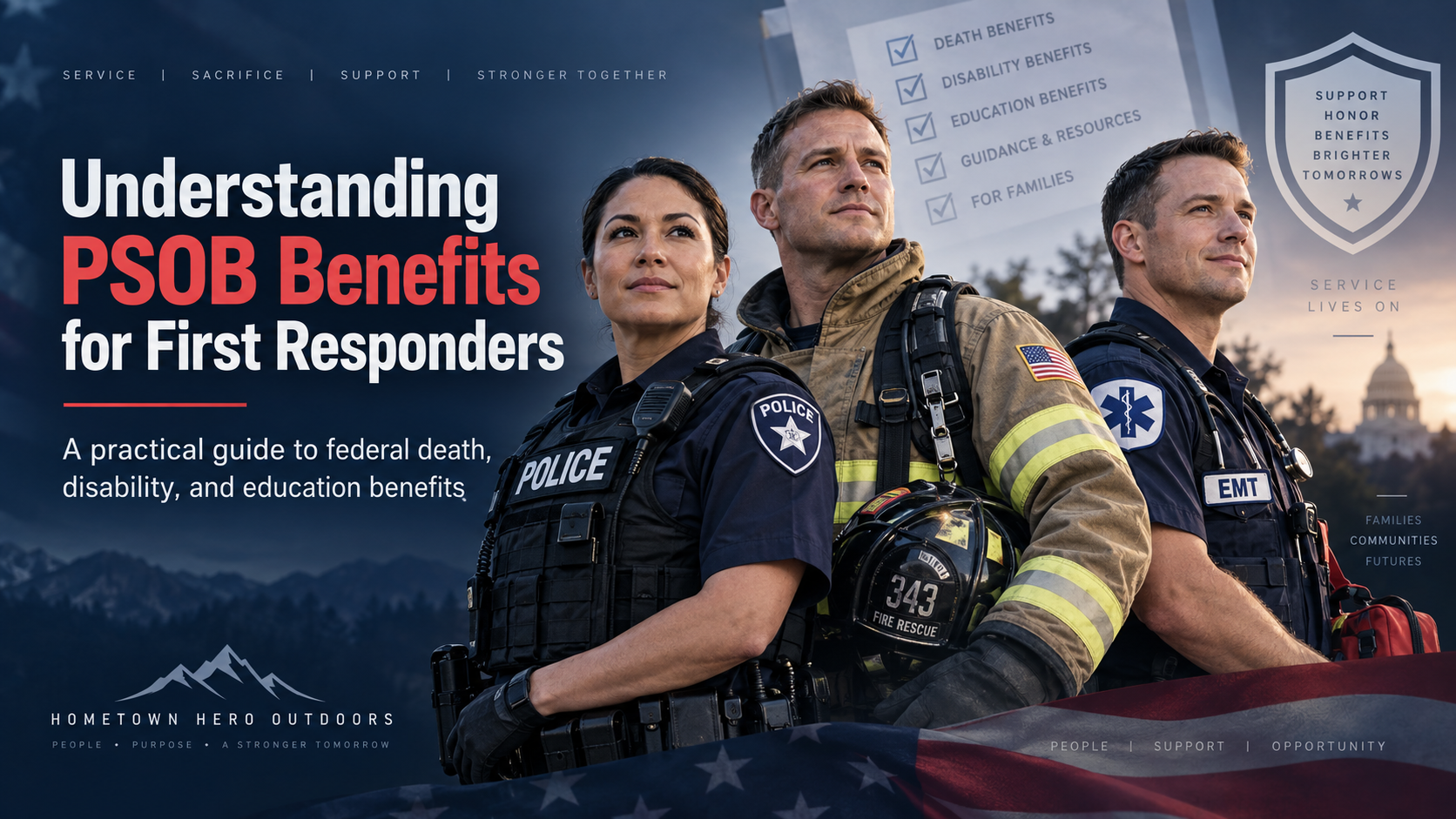
A practical guide to federal death disability and education benefits
When a public safety officer dies or becomes permanently and totally disabled because of a line-of-duty injury, families and officers may qualify for a federal benefit through the U.S. Department of Justice. The Public Safety Officers’ Benefits Program, commonly called PSOB, can provide a substantial one-time payment and may also support a spouse’s or child’s education. It is separate from most state workers’ compensation, pension, and employer benefits, and it is not limited to deaths caused by violence.
The program is valuable, but eligibility is fact-specific. A claim must establish the officer’s covered status, a line-of-duty injury, and the required connection between that injury and the death or catastrophic disability. The practical message is simple: do not assume a case is excluded, and do not wait to begin collecting records and contacting the officer’s agency.
What PSOB Is
PSOB is administered by the Bureau of Justice Assistance within the U.S. Department of Justice. It has three related benefit programs:
| Benefit | Who may receive it | What it provides |
| Death | Eligible survivors | A one-time benefit when a covered officer’s death is the direct and proximate result of a personal injury sustained in the line of duty. |
| Disability | The injured officer | A one-time benefit when a line-of-duty injury permanently leaves the officer functionally incapable of performing work, including sedentary work. |
| Education | Eligible spouses and children | Monthly assistance for approved higher education or training, generally for up to 45 months of full-time study or the proportional equivalent for part-time study. |
For eligible deaths and catastrophic injuries occurring on or after October 1, 2025, the fiscal year 2026 PSOB amount is $461,656. The fiscal year 2026 education rate is $1,574 for one month of full-time assistance on or after October 1, 2025. Benefit rates are adjusted each October, and the applicable payment can depend on the date of death or injury and, for claims pending more than 365 days, the date of final determination. Always confirm the current amount on the official Benefits by Year page.
Who Can Be Covered
Federal law defines “public safety officer” more broadly than many people expect. Coverage can include paid or volunteer personnel serving in an official capacity, including:
• Law enforcement officers, including police, corrections, probation, parole, and qualifying judicial officers.
• Career and volunteer firefighters, including certain volunteer members whose primary emergency-response duty is scene security or traffic management.
• Members of qualifying public or nonprofit rescue squads and ground or air ambulance crews who are authorized or licensed to perform rescue or emergency medical services.
• Officially recognized chaplains serving police or fire organizations while responding to a police, fire, or rescue emergency.
• Candidate officers in a formal police, fire, rescue, or EMS training program while participating in a formal or required program activity.
• Certain FEMA, state, local, tribal emergency-management, civil-defense, and Department of Energy personnel performing specifically covered hazardous duties.
Job title alone does not decide eligibility. The employing entity, the officer’s official role, whether the activity was within the line of duty, and the facts of the incident all matter. Volunteers and some nonprofit EMS or rescue personnel may qualify, while a private-sector first responder may not qualify unless the organization and service meet the statute’s requirements.
What Counts as a Covered Injury
The core rule is that the death or permanent and total disability must be the direct and proximate result of a personal injury sustained in the line of duty. “Injury” is not confined to a gunshot, collision, fire, or other single traumatic event. Depending on the facts and applicable law, it may include occupational disease, infectious disease, certain cardiovascular events, and qualifying psychological injuries.
Heart attack stroke and vascular rupture
Federal law creates a presumption for certain fatal heart attacks, strokes, and vascular ruptures. In general, the officer must have engaged while on duty in qualifying nonroutine stressful or strenuous activity, or in a qualifying training exercise, and the event must begin during that activity, while the officer remains on that duty, or within 24 hours afterward. The presumption can be overcome by competent medical evidence showing the event was unrelated or caused by something other than the mere presence of cardiovascular risk factors.
Post traumatic stress and suicide related claims
The Public Safety Officer Support Act of 2022 changed PSOB law to recognize the impact of traumatic duty exposures. Qualifying post-traumatic stress disorder, acute stress disorder, and other trauma- and stress-related disorders may be treated as line-of-duty personal injuries when duty exposure to one or more defined traumatic events was a substantial factor. The law also permits consideration of death or permanent and total disability resulting from an action intended to cause the officer’s death when the statutory connection to duty-related traumatic exposure is established. These claims are not automatic; documentation of the duty exposure, condition, treatment or help-seeking when applicable, causation, and resulting death or disability remains critical.
Certain occupational cancers
A major expansion signed into law on December 18, 2025, recognizes certain deaths and permanent and total disabilities caused by cancers linked to line-of-duty exposure to listed carcinogens. DOJ states that a claimant will need to document a qualifying duty exposure, at least five years of service before diagnosis, separation from service less than 15 years before diagnosis, and that the cancer caused the officer’s death or permanent and total disability. The new presumption applies to covered deaths on or after January 1, 2020, and to qualifying cancer diagnoses received on or after that date. Because this provision is new and depends on listed cancers and carcinogens, families and agencies should consult PSOB directly rather than deciding informally that an older or occupational-cancer case is ineligible.
COVID 19 and other infectious disease
Infectious diseases may qualify when the required line-of-duty connection is proven. Congress also created special COVID-19 presumptions for defined duty periods and conditions. Those rules are date-specific, including a statutory termination date no later than December 31, 2023, so a COVID-related claim should be evaluated under the exact dates and evidence rather than a general assumption.
Who Receives a Death Benefit
PSOB follows a federal order of payment, not simply a will or the ordinary probate process. In general:
• If there is a surviving spouse and no eligible child, the spouse receives the benefit.
• If there is a surviving spouse and at least one eligible child, 50 percent goes to the spouse and 50 percent is divided equally among the eligible children.
• If there is no surviving spouse, eligible children share the benefit equally.
• If there is no spouse or eligible child, payment may go to a properly designated PSOB beneficiary on file with the public safety agency, or, if none, to the beneficiary of the most recently executed life-insurance policy on file with the agency.
• If none of those people qualify, surviving parents may receive the benefit; a final statutory category addresses certain adult children who would meet the child definition but for age.
The statutory definition of an eligible child includes natural, adopted, posthumous, and stepchildren who meet the applicable age, student, or disability criteria. Family structure and beneficiary records can create difficult questions, so claimants should disclose all potentially eligible survivors and allow PSOB to determine the proper distribution.
How to File a Claim
All new PSOB claims are filed through the online PSOB portal. Death and disability claims each have two parts: Part A is completed by the claimant, officer, or authorized representative, and Part B is completed by the employing public safety agency. The portal generates a customized document checklist based on the answers provided.
1 Start the claim Create an account at the official PSOB portal and begin the appropriate death, disability, or education application.
2 Notify the agency Identify a dependable agency representative who can complete Part B and gather official personnel, incident, and benefit records.
3 Build the record Upload the requested documents. Do not assume that an agency line-of-duty finding, workers’ compensation award, or pension determination automatically controls the federal decision.
4 Monitor the portal Respond promptly to requests for missing documents or clarification. A claim is not complete until both application parts and the required supporting materials are submitted.
5 Review the decision PSOB issues a written determination. Approved benefits are paid through the U.S. Treasury, generally by direct deposit. A denial explains appeal rights.
Documents to Begin Collecting
The portal’s customized checklist controls, but families, officers, and agencies can reduce delays by locating records early. Depending on the claim, PSOB may need:
• Proof of the officer’s employment, official status, appointment, volunteer membership, or training-program status.
• The agency’s complete investigative report, incident reports, witness statements, dispatch or activity records, training records, and line-of-duty determination.
• A death certificate, autopsy and toxicology reports, medical records, and a clear medical explanation connecting the duty injury or exposure to the death or disability.
• For disability claims, medical evidence addressing permanence, functional limitations, and the inability to perform work, including sedentary work.
• Marriage, birth, adoption, stepchild, student-status, dependency, guardianship, and other records needed to establish each potential beneficiary.
• Agency benefit records and any relevant workers’ compensation, pension, retirement, or other governmental findings.
• For mental-health claims, records of duty-related traumatic exposures and relevant clinical, treatment, EAP, peer-support, or help-seeking evidence, as appropriate and requested.
• For cancer or occupational-disease claims, service history, exposure documentation, diagnosis and pathology records, and medical causation evidence.
A practical best practice for agencies is to identify one point of contact, preserve the full record immediately, and communicate regularly with the claimant. Families should keep copies of every upload and note the date of every submission and conversation.
Deadlines and Appeals
Do not delay filing. Under the regulations, a death claim generally must be filed within three years after the officer’s death, and a disability claim generally within three years after the injury date. The regulations contain alternative timing rules and allow extensions for good cause in some circumstances, but those provisions should not be treated as permission to wait. If a deadline may have passed, contact PSOB and consider filing rather than assuming the claim is lost.
If PSOB denies a claim, the claimant generally has 33 days to request review by a Hearing Officer. A second administrative appeal to the BJA Director also generally must be filed within 33 days. Because those windows are short, read the determination immediately and seek experienced assistance if needed.
Education Assistance for Spouses and Children
The Public Safety Officers’ Educational Assistance program can support eligible spouses and children of officers who died or became permanently and totally disabled in the line of duty. It may cover approved undergraduate, graduate, professional, technical, or vocational education and training. The program generally provides up to 45 months of full-time assistance, or a proportional period for part-time attendance.
The process begins with an education prescreen to establish general eligibility. After the prescreen is accepted, the applicant submits a payment application for the applicable enrollment or grading period. Age limits, timing, program approval, prior assistance, and other rules can affect payment, so students should apply early and confirm eligibility before relying on the benefit to meet a tuition deadline.
Important Points Families and Agencies Should Know
• PSOB is a federal benefit. A state or local line-of-duty designation is important evidence but does not guarantee the federal result.
• The death or disability benefit is generally in addition to benefits from other sources, although federal law identifies specific offsets and prevents duplicate PSOB death and disability benefits for the same officer.
• Disability coverage is narrow. A serious injury or medical retirement does not by itself satisfy the federal standard; the injury must permanently prevent work, including sedentary work, subject to statutory rules for limited, therapeutic, nominal, or specially accommodated work.
• A claim can involve delayed illness or a condition that develops after the original exposure or injury. Preserve employment, exposure, incident, and medical records even when no claim is immediately expected.
• No one should demand money or sensitive information while claiming to be BJA through an unsolicited text. DOJ warns about impersonation scams and advises claimants to use the portal, official email, or the published PSOB telephone number.
Where to Get Help
Official PSOB portal and program information: psob.bja.ojp.gov
Bureau of Justice Assistance PSOB overview: bja.ojp.gov/program/psob
PSOB telephone: 1-888-744-6513, generally 8:00 a.m. to 4:30 p.m. Eastern Time
PSOB email: [email protected]
Law-enforcement survivor assistance: Concerns of Police Survivors at 573-346-4911
Fire-service survivor assistance: National Fallen Firefighters Foundation at 301-447-1365
Official Sources
BJA Public Safety Officers’ Benefits Program
BJA Benefits and Application Instructions
BJA PSOB Resources and Current Benefit Amounts
BJA PSOB Law and Regulations including 2025 cancer expansion
PSOB Program Fact Sheet January 2025